Most people who are buying or selling a home keep a close eye on interest rates, but they may not know that interest rates affect home prices and affordability. Understanding the relationship can help you figure out what to watch for, when to make a move, and when to wait it out.
The Basic Relationship Between Interest Rates and Home Prices
Interest rates and home prices are inversely related. This means that:
- When interest rates go up, home prices typically go down (or at least stop growing as quickly).
- When interest rates go down, home prices typically go up.
The relationship between interest rates and home prices is not direct. Instead, interest rates affect what people can afford in monthly payments, which affects what they can spend on a home, which affects home prices.
Here’s an example of how the relationship between interest rates and home prices works:
Bob and Sue are buying a home for $400,000. They have a 20% down payment, so they need a mortgage for $320,000.

With each hike in interest rates, Bob and Sue’s monthly payments are higher, and they pay much more in interest over the course of the loan. But how does this affect actual home prices?
The change in interest rates affects home prices because most people have a monthly budget for housing. That affects what they can reasonably afford and what size mortgage they would qualify for.
Let’s say Bob and Sue have a monthly budget of $2,000 for mortgage payments. Assuming they have a 20% down payment, this is what they could afford:
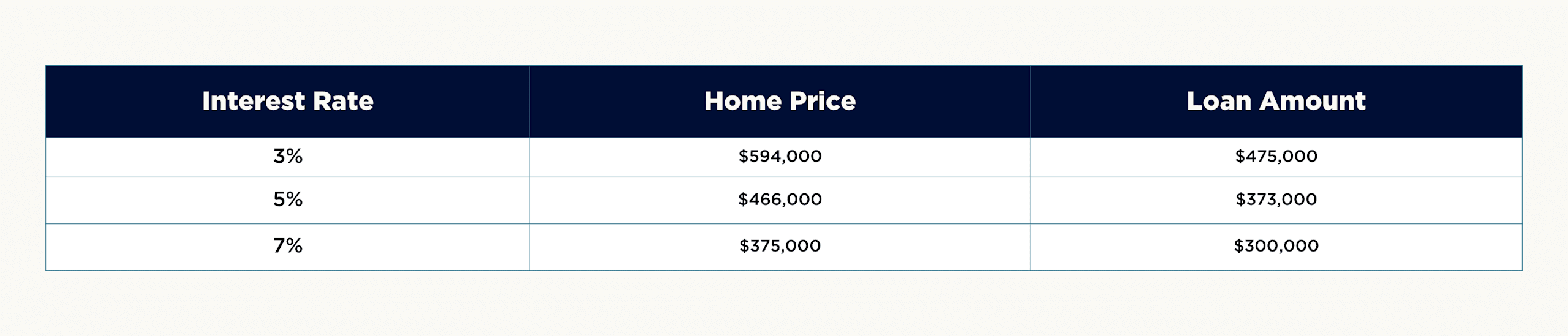
With a 4% rise in interest rates, Bob and Sue can only afford a home priced at $375,000, over $200,000 less than what they could afford if interest rates were at 3%. If this only affected one home buyer, it wouldn’t have much of an effect, but at any one time, there are millions of home buyers in the market.
With a 4% rise in interest rates, Bob and Sue can only afford a home priced at $375,000, over $200,000 less than what they could afford if interest rates were at 3%. If this only affected one home buyer, it wouldn’t have much of an effect, but at any one time, there are millions of home buyers in the market.
The Ripple Effect of Interest Rate Changes
The example above doesn’t tell the entire story of the relationship between interest rates and home prices. To understand the big picture, you have to consider the ripple effect.
When Interest Rates Rise
When interest rates rise, the following things happen:
- Buyer purchasing power may decrease:
- People who could afford a $500,000 house may now only afford $400,000, so they will probably start looking at lower-priced homes.
- Demand shifts:
- There’s may be more competition for lower-priced homes and less competition for higher-priced ones.
- Mid-tier homes may be heavily impacted because these are the ones buyers who are now looking at entry-level homes would have been bidding on.
- Sellers could be forced to make adjustments:
- Homes may sit on the market longer.
- Sellers may have to reduce prices to attract buyers.
- Growth in home prices may slow or reverse.
When Interest Rates Fall
When interest rates drop, the opposite trends develop:
- Buyer purchasing power may increase
- People might be able afford more expensive homes.
- Buyers who were completely priced out of the market might be able to now enter it.
- Overall demand may increase
- More buyers may start looking at the same homes.
- Bidding wars might become more common.
- Sellers could possibly gain ground
- Homes might not sit on the market as long.
- Sellers might ask for higher prices.
- There could be less negotiation on price or conditions.
- Home prices may rise
- Values could start to appreciate faster.
- Some markets might heat up significantly.
- Entry-level buyers could be priced out of the market.
Other Factors Affecting the Relationship Between Interest Rates and House Prices
The relationship between interest rates and house prices isn’t perfect. Several other factors can affect it:
Housing Supply
If there aren’t enough homes to meet demand, prices may stay high even when rates rise, because buyers are competing for limited inventory.
Local Housing Market Variation
Local markets can be very different from national trends. For example, an area with a booming tech industry might see continued price growth even when rates are high. In contrast, a traditionally industrial area where factories are closing might see falling prices even when rates drop.
The State of the Economy
When the economy is strong, wages typically rise and unemployment drops. Under these conditions, people can afford higher payments even with higher rates.
Time Lag
Markets don’t automatically adjust to changes in interest rates. It can take some time for rate changes to have their full effect on home prices.
Homeowners’ Reluctance to Sell
Homeowners who locked in their mortgage at a low rate may not want to sell when rates rise because their new mortgage would be at a higher rate. Even if someone offers them a great price, the difference in their monthly payments may not be worth it. This effectively reduces supply, creating a shortage, which can keep prices high even with higher interest rates.
How the Federal Reserve Rate Affects Interest Rates
If you’re watching mortgage interest rates, you might be curious about the role the Federal Reserve rate plays in influencing mortgage interest rates.
The Federal Reserve rate is the rate banks charge each other for overnight borrowing. The Fed changes rates to keep the economy healthy. Higher rates cool the economy down and control inflation; lower rates give the economy a boost.
The Fed rate and mortgage rates are connected through a complex system of investor expectations and signals that investors get from the Fed. The connections are complicated, but they’re fairly consistent and reliable.
If you’re interested in the actual mechanisms, the Fed rate influences mortgage rates through three channels that are loosely related:
- Mortgage rates are usually based on 10-year Treasury Bond yields, not the Fed rate directly.
- Lenders also base mortgage rates on mortgage-backed security yields. When the Fed raises rates, it signals to investors that it’s concerned about inflation. Investors then drive Treasury Bond yields up because that protects the investors against inflation. Yields for mortgage-backed securities follow suit because they compete with Treasury Bonds for investor dollars.
- The Fed also buys and sells bonds directly. Buying them pushes rates down, and selling them pushes rates up.
Understanding these details is absolutely not necessary. As long as you know that the Fed rate affects interest rates, you’re on solid ground.
What the Relationship Between Interest Rates and Home Prices Means for You
Getting out of economics class and back to the front lines, here’s how the relationship between interest rates and home prices affects actual home buyers and sellers: